
10-Bit Video for Archival Digitization: SNR Numbers for Common Tape Formats and the Case for 10-Bit Capture (Part 2)
SNR Numbers for Common Tape Formats and the Case for 10-Bit Capture
This is part two of a two-part series. Part 1 covered the fundamentals of bit depth, noise, and signal-to-noise ratio. This post compiles published SNR specifications for common analog tape formats and uses that data to answer the question: is 10-bit capture actually worth it?
A Quick Refresher
In Part 1, we established a key principle: the quantization noise floor of your digitization must be lower than the analog noise floor of the tape. If it isn't, the digitization process itself is adding visible noise to the image, making the capture worse than the original.
We also calculated the theoretical quantization SNR for standard bit depths:
| Bits | Quantization SNR |
|---|---|
| 8-bit | 49.92 dB |
| 10-bit | 61.96 dB |
| 12-bit | 74.00 dB |
The question is: where do common tape formats actually fall relative to those numbers? To answer that, we need real-world SNR data from manufacturer documentation.
A Note on These Numbers
The SNR values below come from original manufacturer service manuals, product brochures, and broadcast standards documents. Every value is linked to its primary source so you can verify it yourself.
A few caveats worth keeping in mind. None of these service manuals specify the weighting method used for their SNR measurements. It is likely that most use the industry standard ITU Rec. J.61, section C.3.2.1, but we can’t be certain. There may also be inconsistencies between manufacturers (for instance, whether digital noise reduction was engaged during measurement). Additionally, some manuals list SNR without specifying whether the value applies to VHS mode, S-VHS mode, or both.
In short, take these numbers with a grain of salt. But even with those caveats, the data paints a consistent picture of each format’s performance range.
SNR Numbers for Common Tape Formats
VHS and S-VHS
VHS is widely known for modest video performance. SNR ranges from about 40 to 45 dB depending on the deck, with the best S-VHS machines reaching into the mid-to-upper 40s.
| Deck | SNR (with source linked) | Notes |
|---|---|---|
| JVC HR-3300E | 40 dB | PAL version of the first VHS deck ever produced. |
| Panasonic AG-1950 | 42 dB | Commercial grade VHS deck. |
| Panasonic AG-1960 | 43 dB (VHS), 44 dB (S-VHS) | Early commercial grade S-VHS deck. |
| JVC HR-S5500E | 43 dB | Likely VHS mode, although not specified. |
| Panasonic AG-1970P | 43 dB (VHS), 44 dB (S-VHS) | Commercial grade S-VHS deck. |
| Panasonic AG-1980P | 44 dB (VHS), 47 dB (S-VHS) | Often regarded as one of the best VHS decks ever produced. |
| Sony SVO-9500MD | 45 dB | Commercial grade S-VHS deck, VHS mode. |
| JVC HR-S9800U | 45 dB | Often regarded as one of the best S-VHS decks. Likely VHS mode, not specified. |
| JVC HM-DR10000EU | 45 dB | Likely VHS mode, not specified. |
| JVC BR-S800U | 45 dB (VHS), 46 dB (S-VHS) |
Video8 and Hi8
Video8, introduced by Sony in 1985, was a compact 8mm cassette format for consumer camcorders, designed to compete with VHS and Betamax in a much smaller form factor. Hi8 (High-band 8mm) followed a few years later and significantly improved performance by shifting the luminance carrier frequency, resulting in higher resolution and a cleaner image.
There is surprisingly little official SNR data published for these formats. The vast majority of service manuals don’t include the specification. Here is what we were able to find:
| Deck | SNR (with source linked) | Notes |
|---|---|---|
| Sony EVO-9850 | 45 dB (Video8 and Hi8) | Professional/broadcast grade Hi8 deck. Listed as “More than 45 dB.” |
| Sony EVV-9000 | 45 dB (Video8 and Hi8) | Professional Hi8 camera recorder. |
| Teac Hi8 V800GF | 45 dB (Hi8, color) | Industrial and military Hi8 recorder. |

¾-Inch U-Matic
Sony’s ¾-inch U-Matic format launched in the early 1970s and became the workhorse of broadcast news gathering, industrial production, and education for two decades. It offered a significant step up in quality over consumer formats. Like S-VHS, Sony later released a revision called U-Matic SP with improved picture quality.
| Deck | SNR (with source linked) | Notes |
|---|---|---|
| Sony VP1210AS | 40 dB | Early top-loading model. |
| Sony VP-5000 | 45 dB (color), 47 dB (mono) | |
| Sony VP-7000 | 45 dB | Most likely color. Probably 47 dB monochrome, same as VP-5000. |
| JVC CR-8250U / CR-5550U | 46 dB (color), 49 dB (mono) (source 2) | Professional top-loading units. |
| Sony VO-9850 / VO-9800 | 46 dB (color), 48 dB (mono) | U-Matic SP models. |
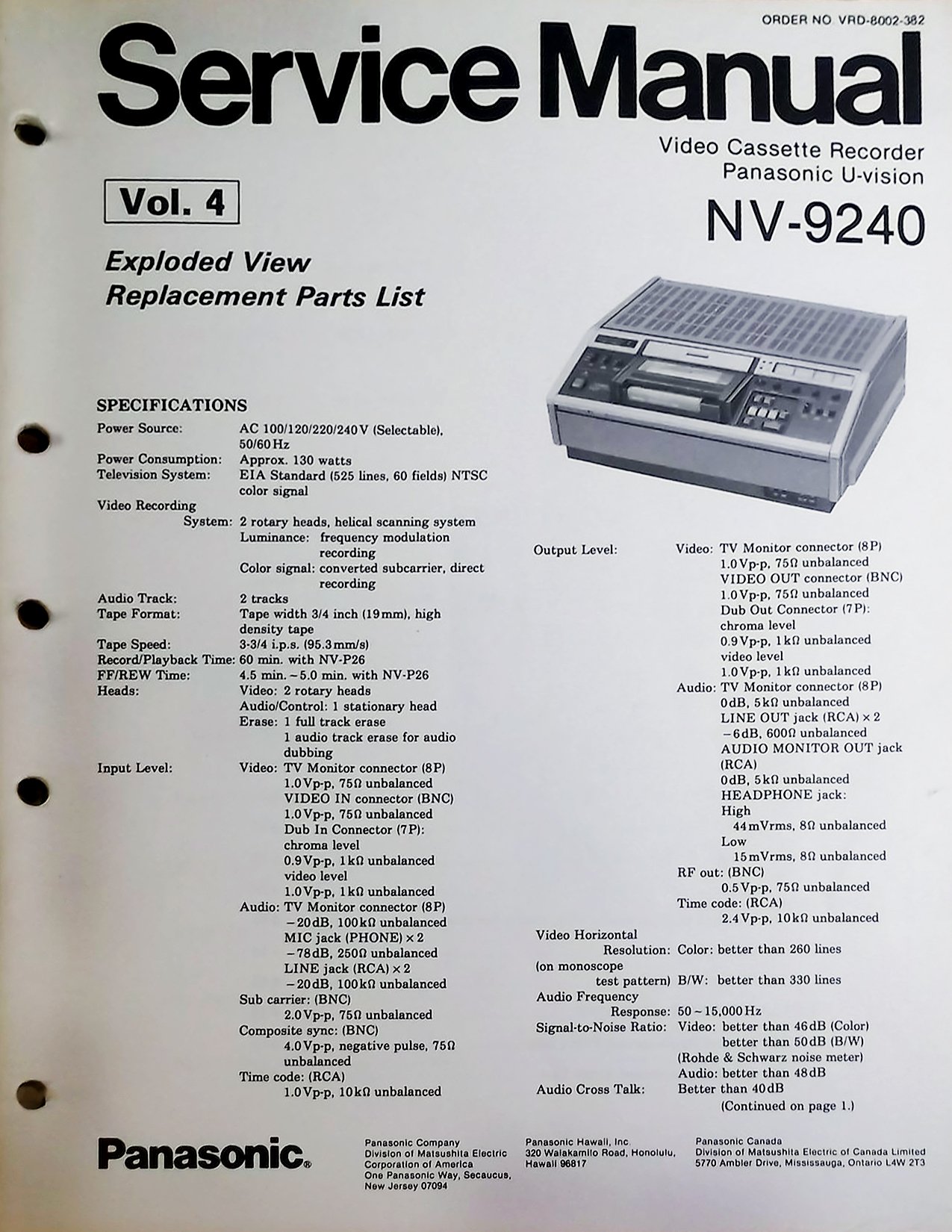
| Panasonic NV-9240 | 46 dB (color), 50 dB (mono) | Panasonic U-Matic machines are very uncommon. I question the validity of the 50 dB monochrome claim, but it’s noteworthy. |
| Sony BVU-950 / 900 / 820 / 800 | 47 dB (color), 49 dB (mono) (source 2) (source 3) | Sony’s highest-end U-Matic SP machines. |
| JVC CR-850U | 47 dB (color) | JVC’s highest-end model. |
Betacam and Betacam SP
A quick clarification: Betacam is not Betamax. The two formats share a cassette shell, but Betacam is a professional component recording format with substantially higher quality, used extensively in broadcast television. Consumer Betamax tapes and Betacam tapes are not interchangeable in practice.
The European Broadcasting Union (EBU) document I18 (“Tolerances on the performance of Betacam and Betacam SP”) provides SNR tolerances with measurement context. Table 1 lists unweighted luminance SNR as at least 48 dB for studio machines and at least 47 dB for budget machines. Note that these are unweighted values; weighted measurements would be even higher.
Those numbers hold true for the decks we’ve found data on:
| Deck | SNR (with source linked) | Notes |
|---|---|---|
| Sony UVW-1800 | 49 dB (luma), 52 dB (chroma) | Low-cost SP deck. Metal tape. |
| Sony BVW-75 | 51 dB (luma), 53 dB (chroma) | Broadcast SP deck. Metal tape. |
| Sony PVW-2800 | 51 dB (luma), 53 dB (chroma) | Professional SP deck. Metal tape. |
| Sony DVW-A500 (SP Playback) | 51 dB (luma), 48 dB (chroma) | Digital Betacam deck with analog SP playback. |
1-Inch Type C
Introduced in the mid-1970s, 1-inch Type C became a staple in North American TV broadcasting. The machines were more compact and reliable than the 2-inch Quad machines they replaced, and they recorded a composite signal, which was ideal for a broadcast chain that was already composite. Both Sony and Ampex manufactured Type C equipment.
| Deck | SNR (with source linked) | Notes |
|---|---|---|
| Ampex VPR-1 | 46 dB | First Ampex machine. |
| Ampex VPR-6 | 46 dB | |
| Ampex VPR-3 | 47 dB | |
| Sony BVH-1000 | 48 dB | First Sony machine. |
| Sony BVH-2000 | 48 dB | |
| Sony BVH-3000 / BVH-3100 | 49 dB | Late Sony machine. |
Putting It All Together
Here’s the full picture: the SNR range of each format mapped against the quantization ceilings:
| Format | Typical SNR Range | 8-bit Ceiling (49.92 dB) | 10-bit Ceiling (61.96 dB) |
|---|---|---|---|
| VHS | 40–45 dB | Sufficient | More than sufficient |
| S-VHS | 43–47 dB | Sufficient, but tight at the top end | More than sufficient |
| Video8 / Hi8 | ~45 dB | Sufficient, but tight | More than sufficient |
| U-Matic | 40–47 dB | Sufficient for most decks | More than sufficient |
| U-Matic SP | 46–49 dB | Marginal | Sufficient |
| 1-Inch Type C | 46–49 dB | Marginal | Sufficient |
| Betacam SP | 49–53 dB | Insufficient | Sufficient |
The pattern is clear. For consumer formats, 8-bit is technically adequate. For professional and broadcast formats, 8-bit is either marginal or outright insufficient. And for all formats, 10-bit provides comfortable headroom.
Why “Technically Adequate” Isn’t Good Enough for Archival Work
The table above makes a theoretical case for 10-bit capture on professional formats. But there’s a practical argument for using 10-bit across the board, even for VHS.
Real-World Converters Aren’t Perfect
The quantization SNR formula (6.02 × n + 1.76 dB) describes a mathematically perfect converter. Real-world analog-to-digital converters don’t achieve their theoretical maximum. Noise in the converter’s own circuitry, clock jitter, power supply ripple, and PCB layout all degrade real-world performance. An 8-bit converter that achieves 47 dB in practice instead of 49.92 dB is no longer “sufficient” for a 45 dB VHS tape. The margin has shrunk to just 2 dB.
How Archival Works Handles This
At Archival Works, we digitize in 12-bit and then sample down to 10-bit for the final archival master. Here’s why.
Our 12-bit analog-to-digital converter achieves a real-world SNR of approximately 64 dB. That’s just a hair over 10-bit equivalent performance (61.96 dB theoretical). This means the converter’s actual noise floor sits right at the 10-bit line. By capturing at the converter’s native 12-bit resolution and then mathematically reducing to 10-bit, we can be confident that the final 10-bit file contains the full 61.96 dB of SNR with no converter-induced degradation eating into it.
The result is a true, honest 10-bit archival master. We use 10-bit for every format: VHS, Hi8, U-Matic, Betacam SP, all of it. For access copies and client deliverables, we render down to 8-bit, which is perfectly fine for viewing. But the master is always 10-bit, because the master is the one you can never redo.
Future-Proofing
There’s one more reason to capture at the highest fidelity you can: you only get one shot. Tapes degrade. Binder sheds. Heads wear. The deck you’re using today may not be serviceable in ten years. The archival master you create now may be the last time this tape is ever played. Capturing at 10-bit ensures that if better restoration tools emerge in the future, they’ll have the best possible source material to work with.
Conclusion
The data is clear. Consumer formats like VHS and Hi8 fall within the 8-bit quantization ceiling, but without much margin. Professional formats like Betacam SP exceed it outright. Real-world converter imperfections erode the theoretical margins further.
For archival master files, 10-bit capture across the board is the right call. It eliminates the risk of introducing quantization noise regardless of the source format, it accommodates real-world hardware limitations, and it preserves the maximum amount of original signal (noise and all) for future use.
The difference between 8-bit and 10-bit isn’t about making old tapes look better. It’s about making sure you aren’t making them worse.