
720x486 vs. 720x480: Why Line Count Accuracy Matters
Digital NTSC Resolutions
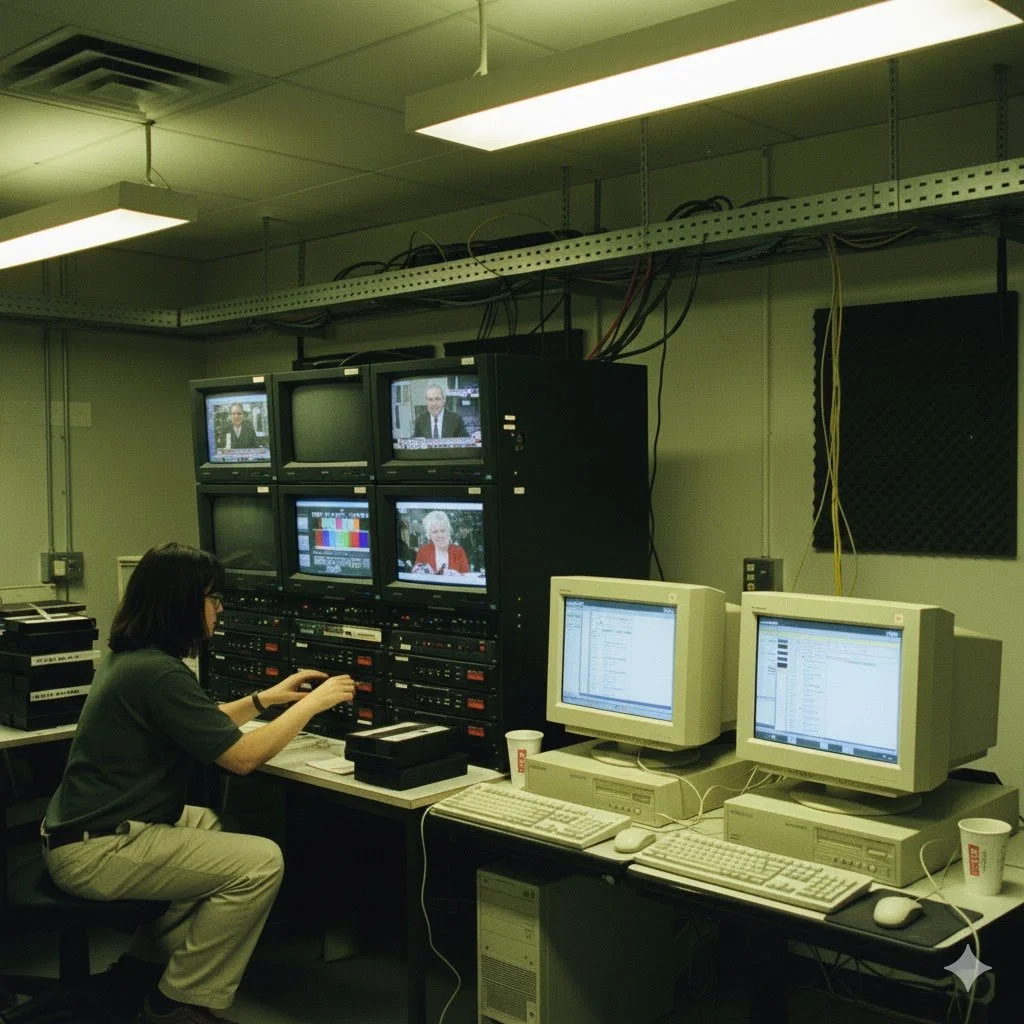
An example of an early digital editing suite. [AI generated]
If you work with NTSC video long enough, you’ll notice that the resolution 720x486 appears frequently, especially in professional video contexts. However, 720x480 is used by DVDs and many consumer formats, which can make it seem like the more “standard” option. After all, 480 is a rounder number. At a glance, the two resolutions look almost identical, and many workflows even treat them as interchangeable.
They are not the same. Understanding why both exist is essential when working with legacy video.
If you care about faithful geometry and archival accuracy, those extra six lines matter. This post explains where each resolution comes from and when each should be used.
Quick Reference: The Basics
If you’re looking for a concise answer, here are the key points:
720x486 is the traditional NTSC digital resolution used in professional video environments.
720x480 is a slightly cropped variant used by DVD, DV, and many consumer formats.
Both use non-square pixels and the BT.601 color space.
The stored frame size does not equal the displayed aspect ratio.
Both formats represent 4:3 video.
For archival-grade digitization, it’s important to understand these relationships rather than defaulting to a single set of capture settings.
Where 720x486 Comes From
NTSC analog video is commonly described as a 525-line system operating at approximately 59.94 fields per second. Not all 525 lines carry picture information; a portion is reserved for vertical blanking, closed captions, and other data.
The number of lines allocated to the visible picture was not strictly defined in the earliest television standards. One of the earliest references appears in the 1966 ITU publication “Documents of the XIth Plenary Assembly, Oslo 1966 Vol V” On page 243, Table 1 specifies that 21 lines per field should be used for blanking.
Blanking is the part of the signal that indicates when a new field begins. If you subtract 21 lines from each field (42 total) from the 525-line system, you’re left with 483 active picture lines.

In the 1970s, line 21 was designated for closed captioning under ANSI-608. Because closed captions are part of the program content, that line could no longer be discarded. As a result, digital video standards needed to preserve it, reducing blanking to 20 lines per field instead of 21.
SMPTE explicitly addresses this in its analog video standards:
“Data signals often found on line 21 (closed captioning for the hearing impaired) are part of the program material. These signals should not be removed (blanked), except when processing (editing, special effects, or time compression) will destroy their usability.”
This change meant that 485 lines of picture data needed to be preserved. Early digital video standards, such as SMPTE ST 125 for SD component video, codified this requirement.
The first digital videotape format, D-1, adopted a resolution of 720x486 (SMPTE ST 227-1996, section 4.1.1). While there is no explicit documentation explaining why this was rounded up from 485 to 486, it was likely done to ensure both fields had equal dimensions, simplifying editing, genlock, and signal processing.
Formats such as D-1, D-2, Digital Betacam, and many professional SD capture cards therefore use 720x486. This resolution represents the full active raster and preserves closed-caption data.
For archival work, capturing the complete active image is ideal. It preserves the original signal faithfully while adhering to long-established professional standards.
Where 720x480 Comes From
If NTSC’s active picture area is roughly 486 lines, why does 720x480 exist?
Early digital compression systems divided images into blocks of 8x8 or 16x16 pixels. For these algorithms to work efficiently, frame dimensions needed to be divisible by 16. Since 486 is not divisible by 16, 480 became the closest practical alternative.

An extreme example of MPEG compression, showing the visible macroblocks
Uncompressed video requires extremely high bandwidth and storage. For consumer applications, such as optical discs, camcorders, and early internet video, this was impractical. Compression made video affordable and accessible, but it required concessions in resolution.
Professional broadcast environments still needed the full 486 lines to remain compatible with analog NTSC standards. These workflows prioritized image integrity over storage efficiency, making heavy compression less critical.
As a result:
720x486 remained the preferred choice for professional and broadcast applications.
720x480 became a compromise that enabled efficient compression, smaller file sizes, and lower-cost consumer formats.
Consumer formats using 720x480 include:
DVD
MiniDV
Many consumer-grade capture devices
Professional formats using 720x486 include:
Digital Betacam
D-1 and D-2
SDI-based systems
It’s also worth noting that 720x480 did appear in some professional workflows, particularly as computer-based editing became more common in the early-to-mid 2000s. DV-derived professional formats such as DVCAM and DVCPRO are examples.
How 720x486 vs. 720x480 Affects Digitization and Preservation
For archives and digitization services, choosing between 720x486 and 720x480 depends on the source and the preservation goal.
Using 720x480 for analog captures may be reasonable for DIY users working with inexpensive, consumer-grade capture hardware. However, for professional and archival purposes, 720x486 is the correct choice.
We capture all analog sources at 720x486 because it preserves the full active image and aligns with professional standards. We always deliver the complete 486-line frame. Modern computers no longer require resolutions to be divisible by 16, making this limitation obsolete.
Cropping analog captures to 720x480 is unnecessary, irreversible, and suboptimal for preservation. We reserve 720x480 only for formats that are natively stored that way, such as DVD, MiniDV, DVCAM, and DVCPRO.
Ultimately, the difference between 720x486 and 720x480 is not academic. It reflects two distinct design priorities that emerged at different points in video history. One prioritizes full signal fidelity and broadcast compatibility, while the other optimizes for compression efficiency and consumer delivery. When working with legacy NTSC sources, understanding this distinction allows you to make informed decisions rather than relying on convenience or convention. For preservation, accuracy matters, and respecting the full active raster ensures that nothing from the original signal is unnecessarily discarded.